My house used to be part of a larger farm, and though I own the land around the house and a field at the back, these old buildings have remained in the ownership of a neighbour. However they let me store my lawn-mower in one of the buildings, and my hens live in another. Plus Charlie, the barn cat has taken up residency and helps keep the mice down (no rats on Graemsay!). Mostly the buildings are now used for storage, but I love looking over them and imagining the folk of old living and working in them.
You can see in the picture above that the buildings are in a "close". But they have been altered many times over many generations. The history of them is unclear, but it is known that a farm has been at Sandside for several hundreds of years, even before these buildings were put up.

The buildings on the left in the photo at the top lost their roof a long time ago. There was a remnant of a roof on this building till a few years ago when a gale finally lifted the remains off. The timbers were rotten through and the slates were just strewn around the yard. But you can see here behind the hay rack, what looks like an old bricked up chimney. And indeed that is what it is, because originally this was a dwelling house where the family lived. But as the building got into poor condition as a house, or maybe the family got larger, another house was built (the one at the end of the close). And this was then turned into byres for the cattle.

The cattle would have been chained up in the stalls (still remains of chains to be seen), and eaten hay from the rack. Other feed would have been in the gulley at the bottom close to the wall. Not sure how they were provided with water in this particular set-up. So heads to the wall and tails to the gutter where all the - er - effluent would have collected, liquid down the drain, the rest to be mucked out by hand.

Three more stalls on the other side. You can see the old slates stacked in a corner - these were what remained after the wind took the roof off!
Meanwhile in another low building, you can see this too was a dwelling house, with evidence of chimneys. This is the house that the family lived in before my house was built in, we think, the mid 1800s.

These stalls are different - big wooden posts with a manger at the end. The one in the middle would have been where the farm horse stood.

Here you can see the partition more clearly.

And this would have been where the horse would have eaten the oats....

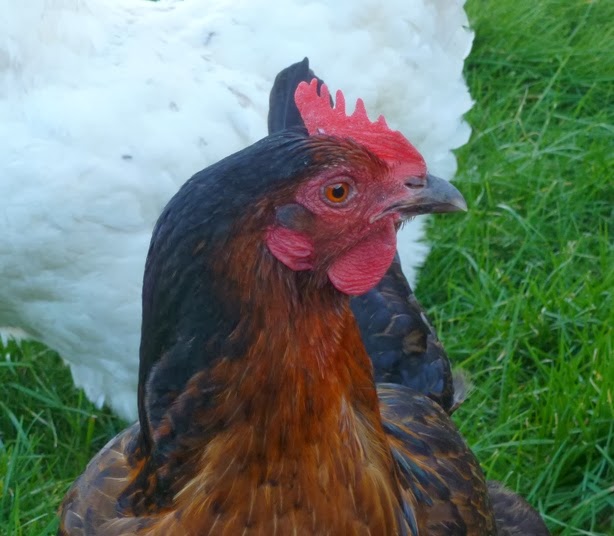
It's a very handy sized..... just big enough for a hen! So my "ladies" enjoy laying here in semi-darkness, nicely protected from wind and rain. One of the eggs bears a blue cross - I always leave an egg in a nesting box to encourage the hens to continue laying. If I remove all the eggs they get the idea very quickly - that I steal their eggs! And they move on to a new site. But seemingly they can't count so as long as there is an egg in a box, they are happy to carry on laying!

Through a doorway is another area where cattle would have been kept. This is more modern, and has had water piped in so the cattle could drink from the small bowls in the middle. Two animals would have been tethered in this stall.

While at the end of this building you can see again evidence it was once a house. The wee alcove in the corner would have perhaps been a cupboard, or at least have had shelves. There are similar alcoves in my house too. Though sadly they had to be covered over during the renovation because of the way the walls were lined - we would have ended up with a cupboard about 1 foot wide!

Outside you can see just how close to the shore these buildings are! You wouldn't be able to build a house so close to the shore nowadays, particularly given the subsidence and coastal erosion along this part of the coast.


This old lean-to is beginning to come away from the main building. About 40 years ago apparently you could drive a tractor round the side of it - now it's subsided and I doubt you'd get a wheelbarrow there!

These old buildings fascinate me and I often wonder about the families that lived in and farmed in them...